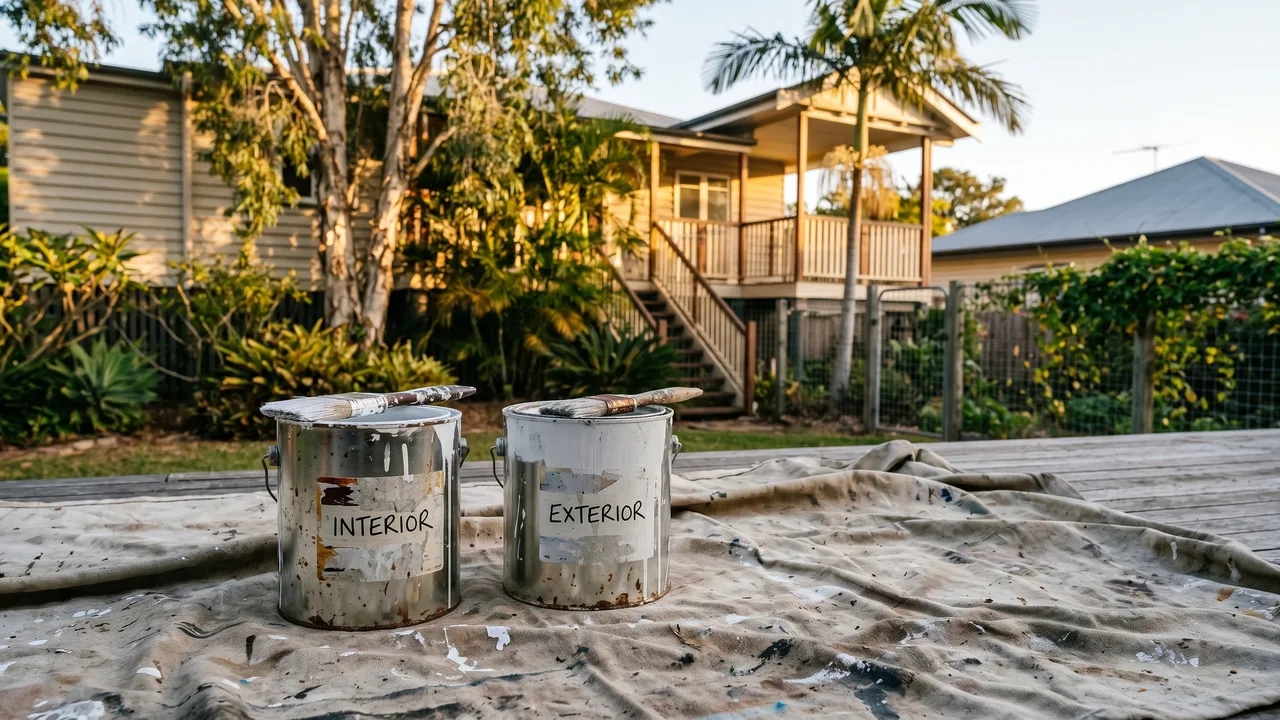
Painter guide
Can you use interior paint outside or does it actually matter?
The Short Answer
Yes, you can put interior paint outside. It will stick. It will cover. And within a few months, it will peel, fade, chalk, and crack in ways that will cost you more to fix than if you had used the right product from the start. So technically possible, practically a bad idea.
What Makes Interior and Exterior Paint Different
The pigments and binders used in paint are not the same across interior and exterior formulas, and the difference matters more than most people realise.
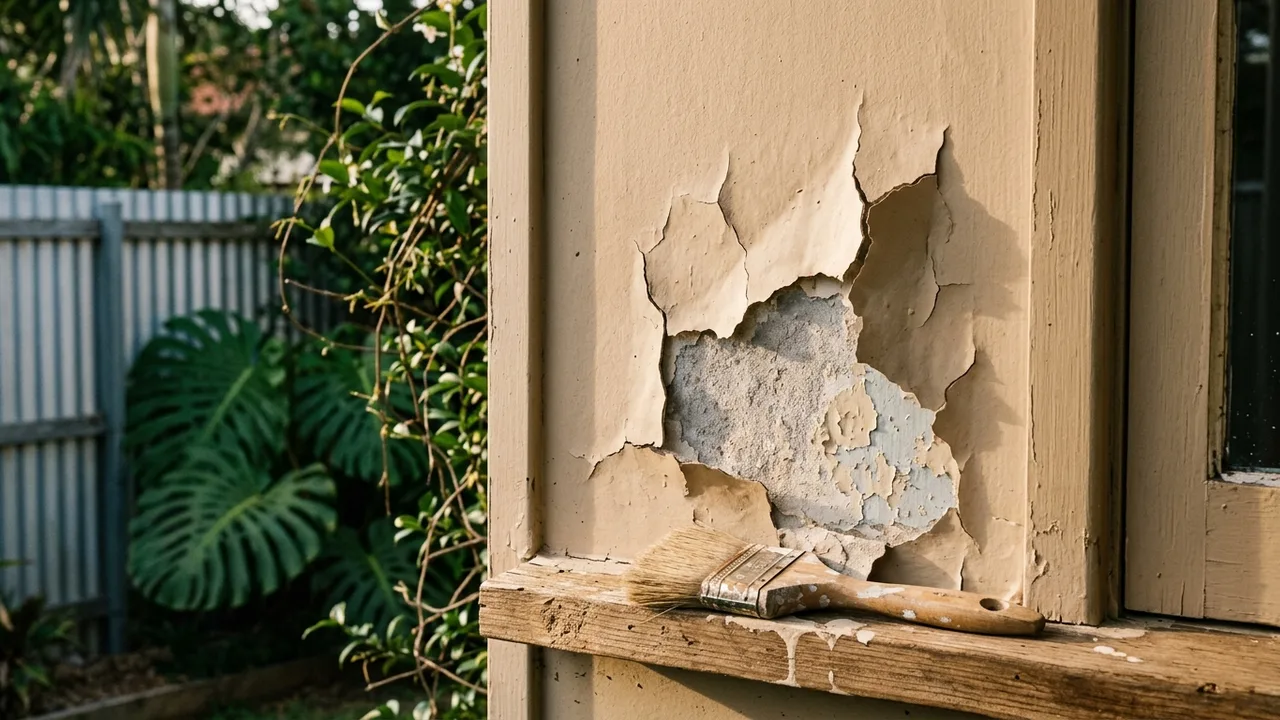
Interior paints are designed for controlled environments. They use harder resins that resist scuffs, washing and everyday contact. They are formulated to handle low UV exposure and stable temperatures. They are not built to flex.
Exterior paints face a completely different set of demands. The binders are softer and more elastic, which allows the paint film to expand and contract as the substrate heats up in the sun and cools overnight. Exterior formulas also contain higher concentrations of UV-absorbing pigments and biocides that slow mould and algae growth on exposed surfaces.
When you use interior paint outside, you are removing all of that engineering. The film becomes brittle. UV light breaks down the binders quickly. The surface fails.
Why Brisbane's Climate Accelerates the Problem
Brisbane is not a mild climate for paint. If you are in Belmont, Carindale, Mount Gravatt or anywhere across the outer east, your exterior surfaces deal with:
- Summer UV intensity that ranks among the highest of any major city in the world. Paint binders degrade faster here than in Melbourne or Sydney.
- High humidity, especially during the wet season from November through March, which encourages mould and algae to colonise any paint film that lacks proper biocides.
- Thermal cycling, where surface temperatures on a north or west-facing wall can swing from around 15°C overnight to 60°C or more on the substrate surface during a hot afternoon. Interior paint film cannot handle that movement repeatedly without cracking.
- Afternoon storms that dump heavy rain onto hot surfaces, stressing any coating that is not designed for rapid temperature change.
Interior paint in this climate typically starts to show visible failure within six to twelve months, sometimes faster on west-facing walls or metal surfaces. An exterior paint properly applied should last eight to twelve years before needing a full repaint, in most Brisbane installations.
What Actually Goes Wrong, and When
The failure modes tend to follow a pattern. First, you notice chalking: a powdery residue on the surface where the binder has broken down and the pigment is left exposed. Then come hairline cracks as the film loses flexibility. After that, moisture works into those cracks and you get bubbling and peeling.
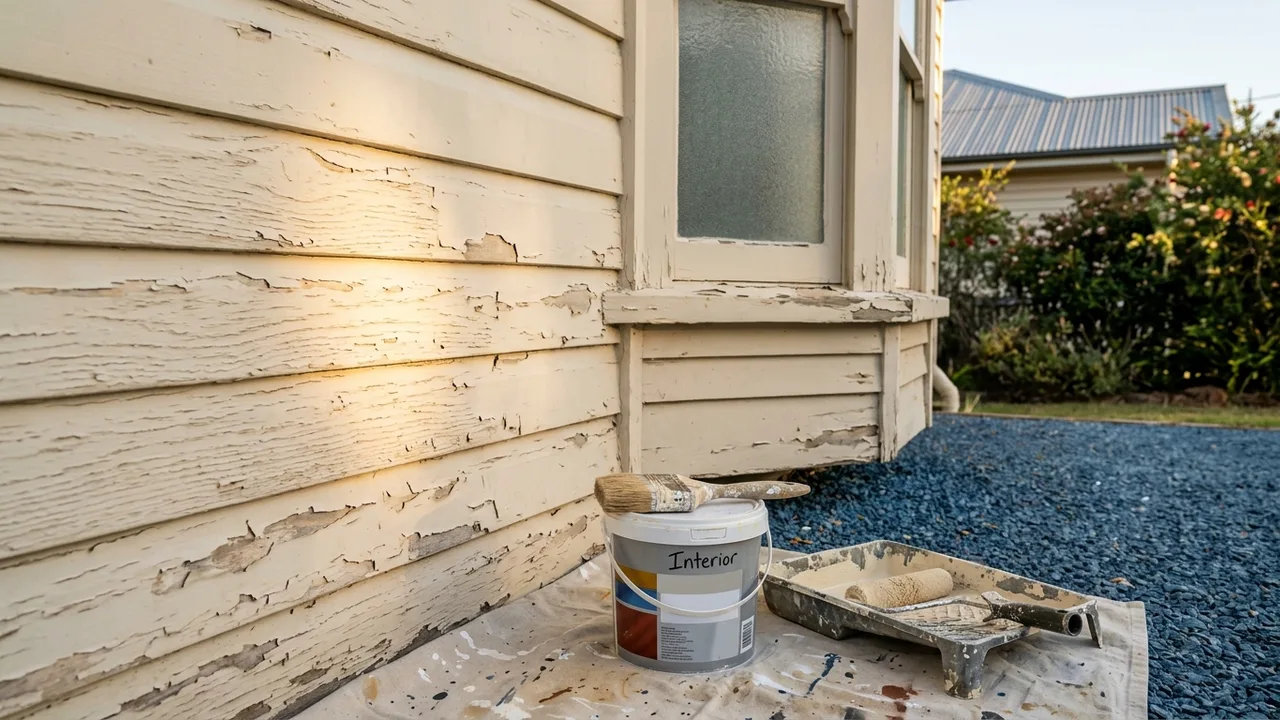
On timber substrates, which are common on older homes in Holland Park, Wishart and the surrounding suburbs, peeling interior paint can expose the timber to moisture damage quickly. Timber that was fine before the paint job can start to swell, rot and require replacement if the failed paint sits for a season or two.
On rendered masonry, the failure is somewhat slower but the remediation is harder. Once paint has chalked and crazed into a rendered surface, the prep work before a proper repaint becomes significantly more labour-intensive. You are typically looking at scraping, sanding, applying a stabilising primer and then repainting. That prep work adds cost that a decent exterior paint in the first place would have avoided.
The honest trade-off: interior paint is usually a few dollars per litre cheaper than a quality exterior formula. On a typical single-storey house, the saving might be $100 to $200 in product cost. The remediation work when it fails would typically run several hundred dollars in prep labour alone, before you have bought any paint.
DIY Scenarios Where This Comes Up
Most people do not set out to use interior paint outside deliberately. It tends to happen in a few specific situations.
Leftover paint from a room repaint. You have half a can of wall paint sitting in the shed and a fence paling that has gone bare. Using it seems logical. For a very small, low-priority, sheltered area, the consequences are limited. A fence section under a covered carport will not face the same UV load as one in full sun. The paint will still degrade faster than it should, but you may get a season or two before it becomes a problem.
Colour matching for a small repair. If you had an interior paint colour matched and you want to touch up a small exterior area with the same colour, do not use the interior product. Take the colour data to a paint supplier and have the formula mixed into an exterior base. Most suppliers can do this. The colour will be close, and the performance will be appropriate for the application.
Not reading the label carefully. Some paints are marketed as interior-exterior. These exist and are legitimate for low-exposure applications like undercover verandahs or interior/exterior doors in sheltered positions. Read the product data sheet rather than just the marketing copy on the front of the tin. The data sheet will specify the intended exposure category.
When a Professional Tells You It Does Not Matter
Occasionally, a tradesperson will suggest that any paint is fine for a particular job. Sometimes that is true for very specific sheltered applications. But if someone is proposing to use interior paint on a full exterior repaint of your Belmont or Rochedale home, that is worth questioning directly. Ask them to specify the product name and check the manufacturer's intended use on the product data sheet. A painter who cannot answer that question clearly is not someone whose work you want on your house for the next decade.
Product selection is part of the trade. It is not a minor detail.
The Sensible Recommendation
If you are doing a small indoor touch-up or working in a fully sheltered interior area, use interior paint. It is formulated for that purpose and it performs well there.
If you are painting anything that faces weather, including walls, fences, decks, fascias or gutters, use a paint that is specified for exterior use. The cost difference at the product level is modest. The difference in how long the job lasts is not.
For a full exterior repaint on a typical home in the Belmont, Carindale or Mount Gravatt area, the job is typically in the $3,500 to $8,000 range depending on size, surface condition and the number of storeys. Getting the product selection right from the start is one of the simplest ways to make sure that investment holds up through Brisbane's summers without needing remediation in year two.
If you are unsure whether a quoted job specifies the right products for your exterior, it is worth having a conversation with a painter who can walk you through the data sheet. A good one will not mind the question.
Quick answers