Painter guide
Should you paint or stain a timber deck in Brisbane's climate?
Should You Paint or Stain a Timber Deck in Brisbane's Climate?
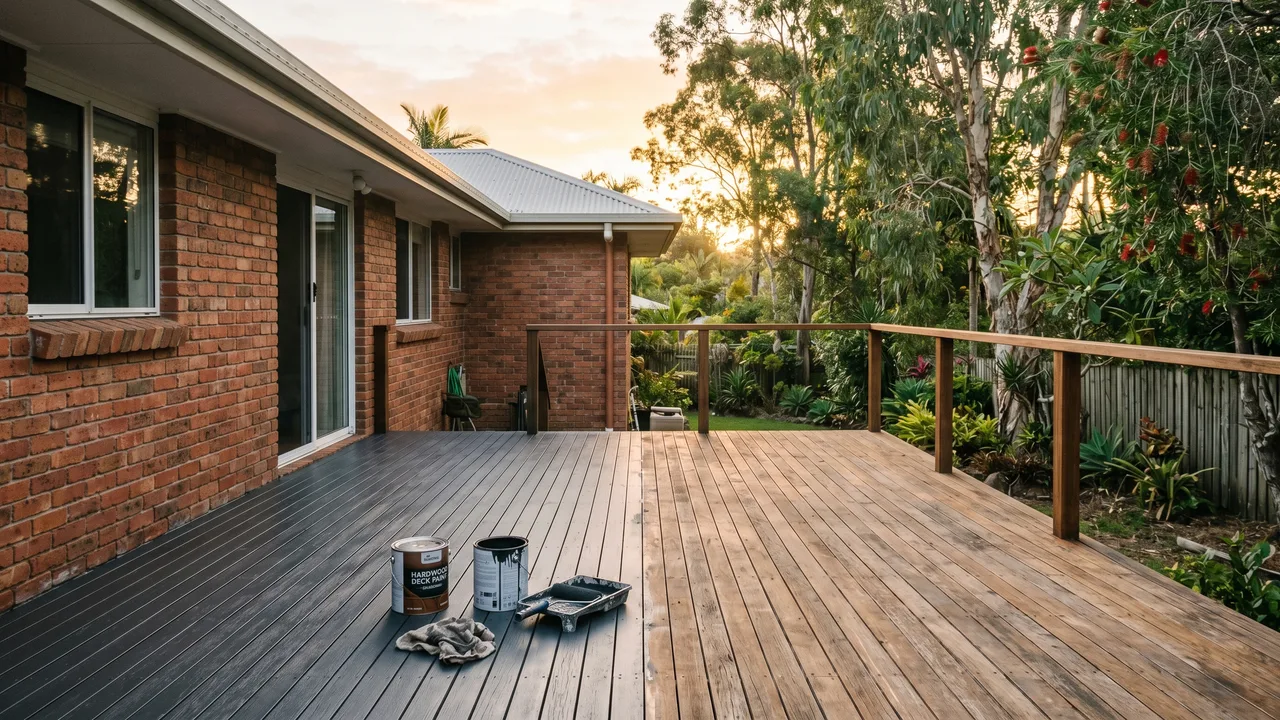
For most Brisbane homeowners, stain is the better starting point - but it depends on the condition of your timber and what you want from the finish. Paint offers more colour choice and better coverage over rough or patchy boards; stain lets the wood grain show through and is generally easier to maintain over time. Neither option is wrong. The right choice comes down to your deck's current state, how much upkeep you're willing to do, and what the local climate will throw at it.
What Brisbane's Climate Actually Does to a Timber Deck
Brisbane sits in a humid subtropical zone. That means long summers with intense UV, heavy rainfall between November and March, and humidity that rarely drops below uncomfortable. For timber decks, this combination is genuinely punishing.
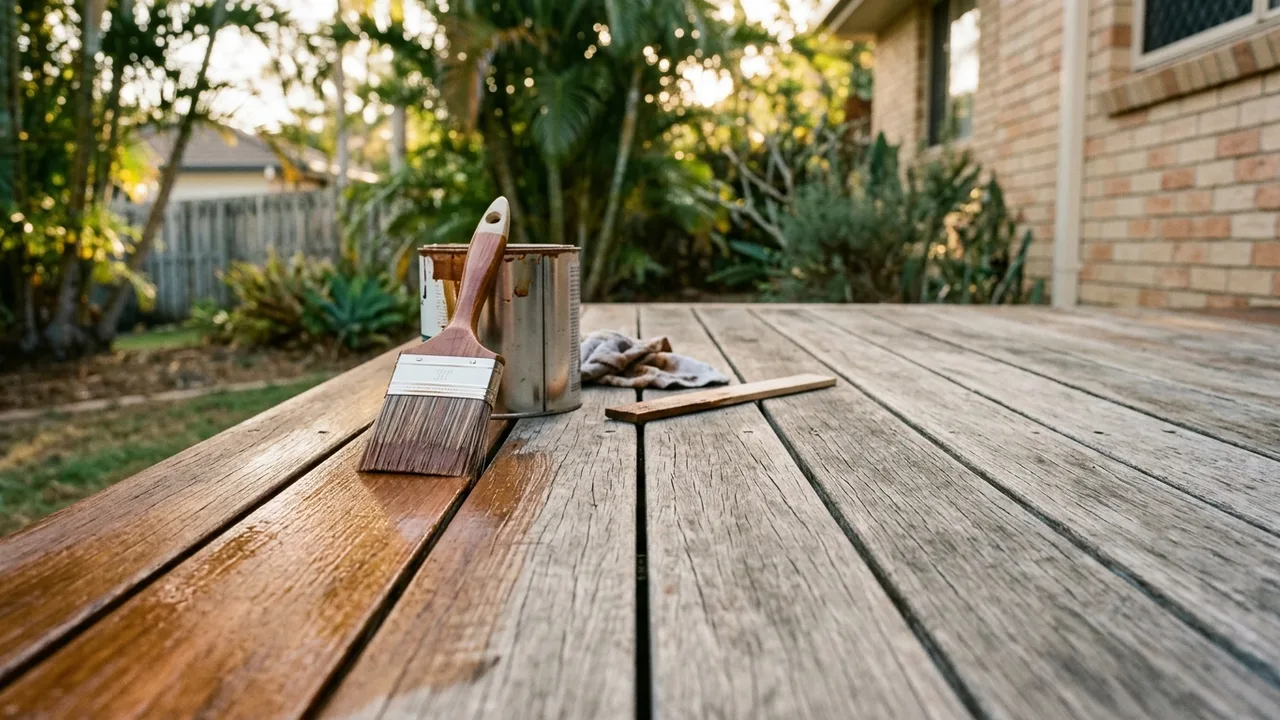
UV radiation bleaches and breaks down timber fibres faster here than in cooler southern cities. The repeated cycle of wet season downpours followed by dry, baking weeks causes timber to expand and contract constantly. That movement is what cracks paint films. It's also what pushes moisture under poorly prepared coatings and starts the rot cycle.
In suburbs like Belmont, Wakerley, and Carindale - where a lot of homes have open, north or west-facing decks - afternoon sun exposure accelerates surface degradation significantly. You'll typically see a good quality deck coating start to look tired within two to three years if it wasn't applied over proper prep work.
The other local factor worth knowing: overhanging trees. Holland Park, Wishart, and parts of Mount Gravatt East have a lot of established native trees and jacarandas. Leaf litter and organic debris sitting on a deck holds moisture against the timber surface. That's a problem for any coating system, but it's particularly unforgiving for paint, because moisture trapped under a solid film has nowhere to go.
The Core Difference Between Deck Paint and Deck Stain
Paint sits on top of the timber surface as a film. It hides the grain, gives you a wide colour range (including solid whites and greys that are popular on Queenslanders), and provides a hard surface underfoot. When it fails, it tends to peel, crack, or bubble - often in patches that look worse than bare timber.
Stain penetrates into the timber fibres rather than forming a surface film. It feeds the wood while protecting it. When it wears, it does so gradually and evenly - you get a faded, weathered look rather than peeling chips. This makes maintenance a lot more manageable. A light sand and a fresh coat every two or three years is typically enough to bring a stained deck back.
Penetrating oil-based stains (sometimes called timber oils or decking oils) are the most common choice for Brisbane conditions. Water-based stains have improved a lot and are easier to clean up, but oil-based products still tend to penetrate more deeply into dense Australian hardwoods like merbau, ironbark, and spotted gum - all of which are common on decks built in the 1980s through to the 2000s across outer east Brisbane.
Semi-transparent stains show the grain clearly. Semi-solid stains add more colour while still letting some texture show. Solid-colour stains look closer to paint but still penetrate rather than film. If you're switching between systems (say, from paint to stain), a professional opinion on compatibility is worth getting before you commit to product purchases.
When Paint Makes More Sense
There are situations where paint is genuinely the better call.
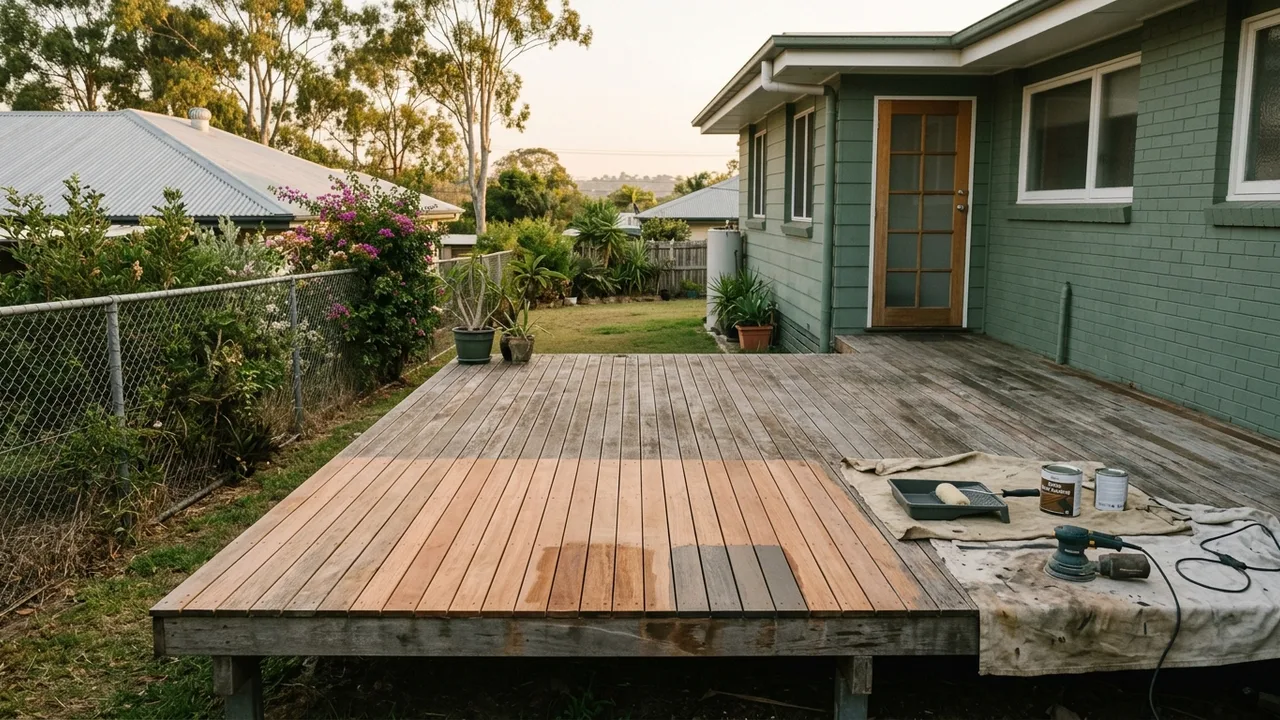
If your deck boards are in poor cosmetic condition - heavily weathered, discoloured, or patchy from previous coatings - a solid-colour paint can unify the surface in a way that stain can't. Stain will show the grain, but it'll also show every variation in colour and texture. Paint hides those imperfections.
Older hardwood decks that have been painted previously are another case. Removing all traces of existing paint before switching to stain is a significant job - often requiring chemical stripping and mechanical sanding that adds time and cost. If the existing paint is sound (not peeling, not cracking), maintaining it with a quality deck enamel or exterior acrylic is often the more practical path.
Paint also gives you design options that stain doesn't. If your deck connects to the house and you want a specific colour match to the exterior scheme - particularly on a traditional Queenslander where a heritage green or charcoal grey floor looks deliberate - paint delivers that outcome more reliably.
The honest trade-off: you're committing to more intensive maintenance. A painted deck that starts to peel needs prompt attention. Left alone, moisture gets in, the timber swells, more paint lifts, and the repair bill grows. Plan for repainting every three to five years, with proper prep each time.
Prep Work: The Part That Actually Determines the Result
This section is worth reading carefully, because it's where most deck coating failures originate.
Whether you choose paint or stain, the preparation work carries more weight than the product itself. Brisbane's humidity means any moisture in the timber at the time of application will cause problems later. Ideally, you want to apply coating after a run of dry weather - which in practice means avoiding the November to March wet season window for any serious deck work.
Basic prep for a deck in reasonable condition includes:
- Pressure washing to remove dirt, mould, and old surface contamination
- Light sanding to open up the timber grain and remove grey oxidised fibres
- Checking for any soft or punky boards that need replacing before coating
- Allowing adequate drying time - at least 48 hours of dry weather after washing, often more for dense hardwoods
For a deck that's been previously painted and is flaking, you're looking at more work: scraping, possibly chemical stripping, heavier sanding, and a quality primer before any topcoat. Skipping or shortcutting this stage is why so many deck jobs look ordinary within 12 months.
A painted deck in a leafy area (think Holland Park or Mansfield with dense tree cover) should also be checked annually for areas of trapped moisture. Clear the deck of debris regularly, especially after rain.
Cost Comparison: DIY vs Professional Application
DIY deck staining or painting is genuinely achievable for a homeowner who's methodical and doesn't rush the prep. A mid-range penetrating oil stain will cost roughly $80 to $150 for a 4-litre tin (enough for around 15 to 25 square metres, depending on absorption). Add sanding materials and a good deck brush or roller, and a small-to-medium deck might cost $300 to $600 in materials alone.
The risk with DIY is not usually the application - it's the prep. Rushing the prep, applying in the wrong conditions, or choosing the wrong product for the timber species are where things go wrong.
Professional application for a typical suburban deck of 30 to 50 square metres typically falls in the $800 to $2,500 range, depending on timber condition, access, the extent of prep required, and the product specified. For decks attached to older homes in Belmont, Carina, or Rochedale where the boards are original hardwood and haven't been touched in years, prep costs can push that figure higher.
The trade-off is straightforward: DIY saves money upfront but carries more execution risk. A professional who preps correctly and uses a quality system will typically give you a result that lasts noticeably longer, which matters when you're comparing two or three-year maintenance cycles.
A Practical Recommendation
If you have a timber deck in reasonable condition and want the most manageable long-term outcome, a quality penetrating stain - applied over proper prep in the dry season - is usually the right choice for Brisbane conditions. It works with the timber rather than against it, and maintenance is simpler.
If your deck is heavily weathered, previously painted, or you want a specific solid colour, paint is a legitimate option - just go in with clear expectations about ongoing maintenance.
Either way, the prep work is non-negotiable. The best product applied over a dirty or damp surface will fail. Take that part seriously, or find someone who will.
If you'd like to talk through your specific deck with a local painter who knows Brisbane conditions, we can connect you with someone experienced in this kind of work across the Belmont area and surrounding suburbs.
Quick answers